
Why We Must Read the Spirit, Not Just the Text, of the Indian Constitution
🔹 Introduction: When the Constitution Speaks in Silence
India is home to a vibrant multilingual culture, and yet, one language has been given a special place in the vision of our Constitution. That language is Hindi — not declared outright as the “national language,” but entrusted with a national purpose under Article 351. While politicians debate and scholars differentiate between official and national language, the Indian Constitution quietly embeds Hindi with the responsibility of representing India’s composite cultural identity. In essence, Article 351 makes Hindi the de facto national language — not by name, but by constitutional design.
🔹 What Article 351 of the Constitution Actually Says
The exact wording of Article 351 leaves little room for ambiguity. It states:
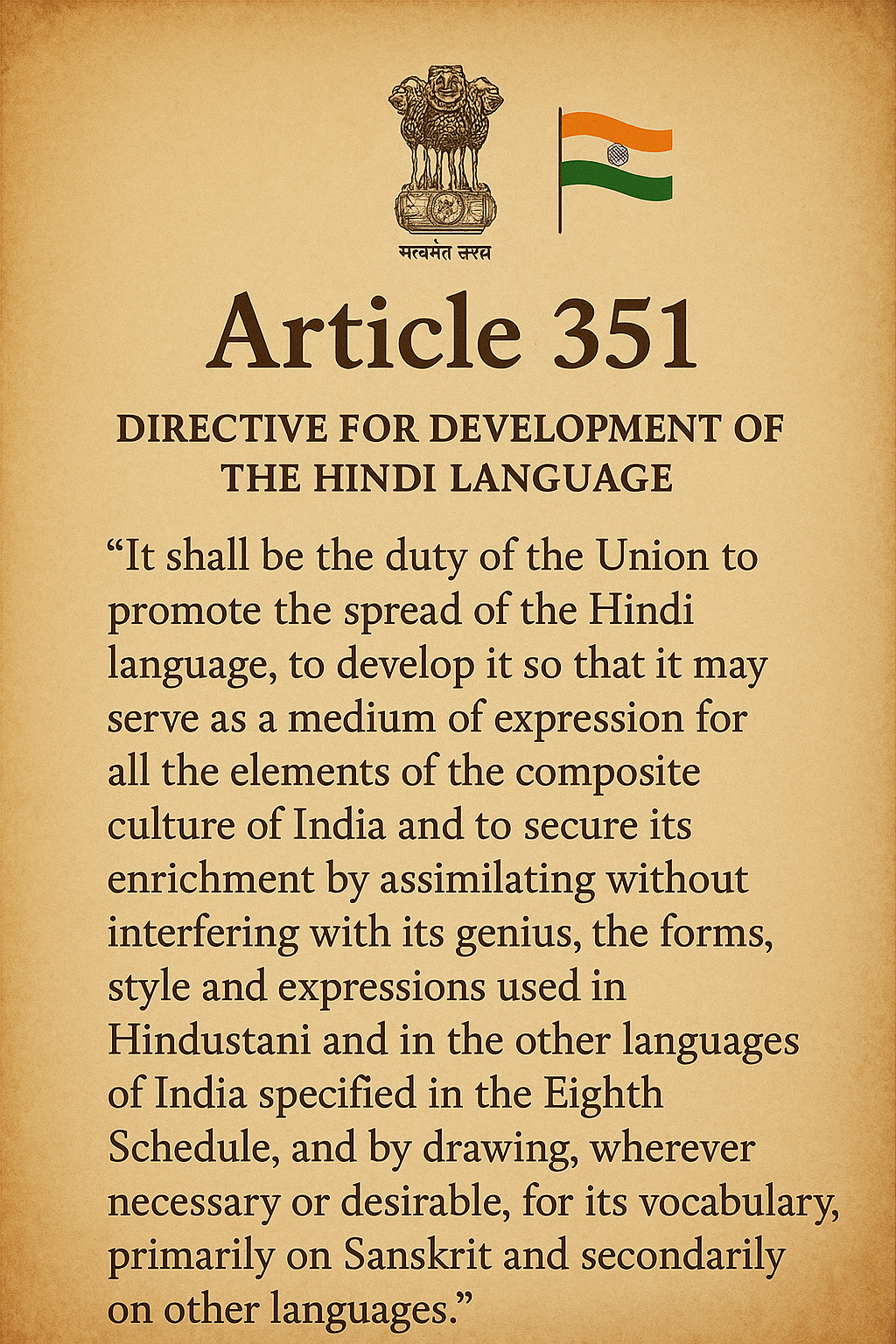
It shall be the duty of the Union to promote the spread of the Hindi language, to develop it so that it may serve as a medium of expression for all the elements of the composite culture of India and to secure its enrichment by assimilating without interfering with its genius, the forms, style and expressions used in Hindustani and in the other languages of India specified in the Eighth Schedule, and by drawing, wherever necessary or desirable, for its vocabulary, primarily on Sanskrit and secondarily on other languages.
This isn’t a symbolic or ceremonial mention. It is a directive constitutional obligation imposed on the Union. It empowers the Central Government to ensure that Hindi is not just used, but developed, modernized, and enriched, so it may become the voice of the nation’s diverse identity.
🔹 Why Hindi Alone Was Chosen for Constitutional Promotion
Among the 22 scheduled languages listed in the Eighth Schedule, only Hindi has been given this kind of promotional mandate. This cannot be dismissed as coincidence or oversight. The framers of the Constitution deliberately selected Hindi — a language already understood by large sections of India — as the most suitable medium to unify communication across regional, linguistic, and cultural barriers. It wasn’t meant to suppress other languages but to harmonize India’s linguistic diversity through a common expressive thread.
🔹 National Duty Without a National Label
Even though India officially states that it has no “national language”, Hindi, by its functions, usage, and constitutional backing, operates as one. It is the primary language used in Parliament, in Central Government correspondence, in national broadcasting, in cultural icons like Bollywood, and in national schemes, courts, and public discourse. In all but name, Hindi performs the duties expected of a national language.
This status is reaffirmed each time a Prime Minister addresses the nation in Hindi, each time a court ruling is translated into Hindi, and each time a central law is published bilingually. That Hindi is not “officially” declared the national language is a technicality, not a reflection of reality.
🔹 Article 351 Promotes Integration, Not Imposition
A frequent criticism is that promoting Hindi could threaten regional languages. But Article 351 itself disproves this fear. It explicitly states that while developing Hindi, due care must be taken to draw upon the vocabulary, expressions, and styles of other Indian languages. The vision is not to elevate Hindi at the cost of others, but to make Hindi the carrier of India’s multilingual essence. This is not linguistic dominance, but linguistic synthesis.
🔹 The Cultural and Practical Logic Behind the Vision
Hindi has roots in Sanskrit, yet it borrows freely from Urdu, Marathi, Punjabi, Bengali, and even Tamil. This makes it naturally flexible and culturally rich. Its presence in cinema, music, politics, and the judiciary is so deep that it already functions as a national connector. It is used not just in Delhi or Uttar Pradesh, but in Mumbai, Hyderabad, Bhopal, Patna, Jaipur, and even by many in southern states for everyday interaction.
Moreover, India’s central services like the Railways, the Armed Forces, and even public sector undertakings regularly use Hindi in internal communication. This behavior pattern is typical of a national language, even without formal nomenclature.
🔹 Why It’s Time to Acknowledge Hindi’s National Role
It is time we look beyond the semantics of “national” vs “official” and acknowledge what Article 351 reveals in spirit. When the Constitution singles out Hindi for national development and assigns it the duty of representing India’s composite culture, it has already given it a national character. Whether or not we call it “rashtra bhasha,” we must recognize that it already plays that role in law, governance, and everyday national life.
🔹 Conclusion: Hindi Is the Nation’s Voice — Constitutionally and Culturally
India does not need a new constitutional amendment to declare Hindi as the national language. We already have one — Article 351. It is our linguistic vision statement, a directive that carries within it the dreams of unity through shared speech. It respects diversity while encouraging national coherence.
Hindi is not a threat to India’s federalism. It is a bridge across its linguistic islands. It is not a tool of imposition but of connection. And most importantly, it is not national by decree — it is national by duty, function, and constitutional spirit.
By recognizing Article 351 for what it truly is, we do not diminish India’s linguistic diversity — we uplift it through a shared constitutional voice called Hindi.
